Wherever machines, engines, or industrial processes are running, heat is generated. Much of this heat has, until now, been released into the environment without being utilized, even though it still contains valuable energy.
This is exactly where Orcan Energy AG comes in. The Munich-based company has developed a solution that converts unused waste heat into electricity. Today, the standardized ORC modules are used in a wide variety of applications, ranging from production and industrial facilities in the cement and steel industries to compressor stations and the maritime sector.
Orcan Energy's systems have now logged more than seven million operating hours, saving over 170,000 metric tons of CO₂ in the process.
However, the more spread out the facilities are, the more important another requirement becomes: Orcan Energy must be able to access them even after they go into operation—regardless of whether they are located in Germany, the Middle East, or North America. To ensure reliable remote access, the company relies on M2M SIM cards from WhereverSIM.
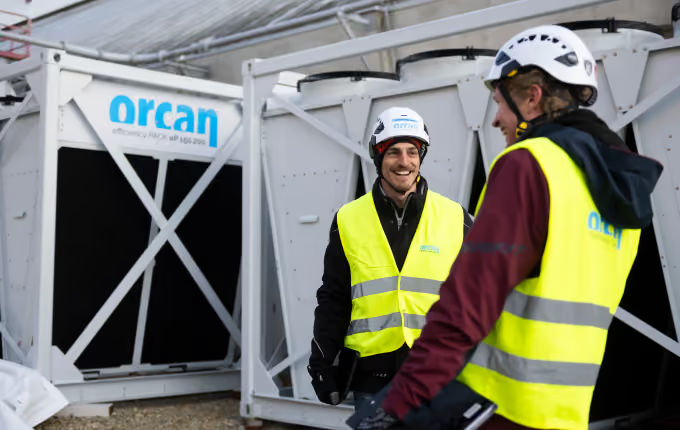
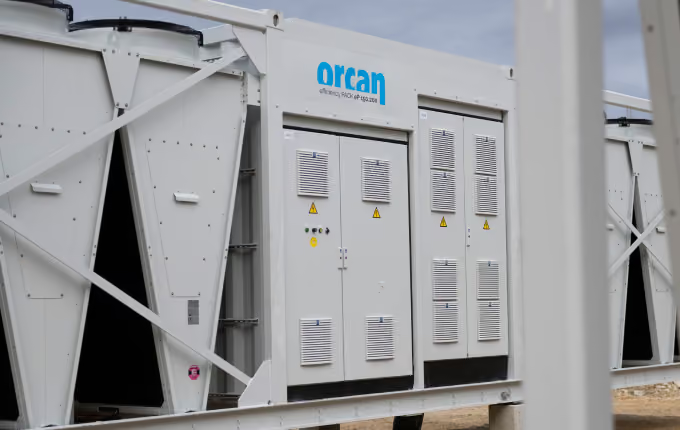
What makes this solution unique is not just the technology itself, but also how Orcan Energy brings it to market. Fabian Weigand, Product Manager at the Munich-based company, explains: “While such systems are traditionally planned and designed individually for specific projects, we work with standardized modules that can be flexibly combined depending on the required output. Customers receive modular systems from a single source that are tailored to their waste heat potential and decarbonization plans.”
The result is a plug-and-play modular system for utilizing waste heat. Instead of designing each system from scratch, Orcan Energy can draw on standardized modules and combine them to suit the specific application. This reduces engineering effort and costs while enabling faster implementation.
Another advantage: The modular design remains flexible even after the system goes live. “If the demand at a location changes, we can install additional modules and expand the system with relative ease,” says Weigand. Instead of a solution developed specifically for a single location, this results in a system that can be adapted to changing requirements even later on.
For Orcan Energy, the plug-and-play concept doesn’t stop at the modules. The necessary connectivity also plays an important role. “If the customer can’t provide their own connection on-site, we simply supply the connectivity ourselves. This ensures that we have independent access to the system at all times,” explains Weigand.
This approach is particularly important when a system is already in operation at the customer’s site. If any anomalies or deviations occur, the Orcan Energy team can remotely access the system to first analyze the underlying cause and determine whether on-site intervention is necessary at all. Software updates can also be performed remotely.
“Not every anomaly means that someone has to go out to the plant. If we can access the system remotely, we can first assess the situation ourselves and, in many cases, provide support right away,” explains Weigand. This makes a difference, especially in international projects: Questions can be answered more quickly and deviations analyzed without requiring a technician to be on site immediately for every single case.
In principle, Orcan Energy could also use the customer’s existing Internet connection for this purpose. But assuming that the customer has one would contradict the plug-and-play approach, Weigand adds: “We provide our customers with the complete package they need, and that includes the M2M SIM card for connectivity if necessary.”
Just as standardization works well for ORC modules, we shouldn't have to start from scratch with connectivity for every new project. While Orcan initially focused primarily on the German market, the systems are now in use internationally.
“It’s crucial for us to be able to deploy our systems internationally without having to start from scratch on connectivity for every new project. After all, we don’t know today where the next project will be implemented,” explains Weigand.
As internationalization increased, the existing connectivity solution began to reach its limits. New countries also meant new requirements for network coverage and availability. Having to reassess for each project whether the existing solution would work at the respective location—or, if necessary, integrate an additional provider—would have increased the workload with every new market.
Orcan Energy wanted to avoid that. The company’s growing international presence was therefore one of the reasons for switching to WhereverSIM. Instead of having to constantly reorganize connectivity for different countries, the company can now use its M2M SIM cards across borders and manage them centrally.
“With WhereverSIM, we have a solution that we can use internationally. One provider, one unified portal—that makes things much easier for us than having to look for a new provider in every country.” For Orcan Energy, connectivity thus follows the same principle as its own modules: It should adapt as flexibly as possible to the specific project, not the other way around.
To ensure that the plug-and-play principle works seamlessly during commissioning, Orcan Energy leaves as little as possible to chance. Before a module leaves the factory, it undergoes a series of tests. Sensors and actuators are checked—as is communication via the M2M SIM card used.
This means the connection is not established only after the system has already been installed at the customer’s site. Orcan Energy can verify even before delivery whether communication is working and whether remote access is generally possible. This allows a potential source of error during subsequent commissioning to be ruled out at the factory. After the tests, the M2M SIM is deactivated again, so that no costs for the SIM card are incurred until the system is finally put into service at the customer’s site.
The WhereverSIM online portal allows you to manage all M2M SIM cards regardless of their location. If a system temporarily does not require a cellular connection, the corresponding SIM can be paused at no cost and reactivated as needed.
International expansion is a key focus for Orcan Energy. North America, in particular, is currently emerging as an exciting market for the company. The expansion of data centers there is driving enormous energy demand while also opening up new opportunities to efficiently utilize existing waste heat.
It is precisely in projects like these that the standardized modular design really shows its strengths. While large, custom-designed systems sometimes involve long planning and delivery times, Orcan Energy can deliver its standardized modules within six to twelve months.
To support further international growth, the company therefore does not need to know today where tomorrow’s systems will be located. Fabian Weigand concludes: “Our systems are designed so that they can be deployed wherever waste heat is generated and can be utilized economically. We want to maintain this flexibility as we continue to grow internationally. And to do that, we need a connectivity solution that is just as flexible and adapts to us and our projects.”