Here you will find exclusive articles about the Internet of Things, our M2M SIM cards and the latest technological developments.
In our Help Center you will find instructions and all the information you need to commission and use our M2M SIM cards. Please note that we sell different M2M SIM cards. Please check which of our SIMs - link+, data+ or tech+ - you are using and select the appropriate help section accordingly.
Frequently asked questions about our M2M SIM card and IoT projects
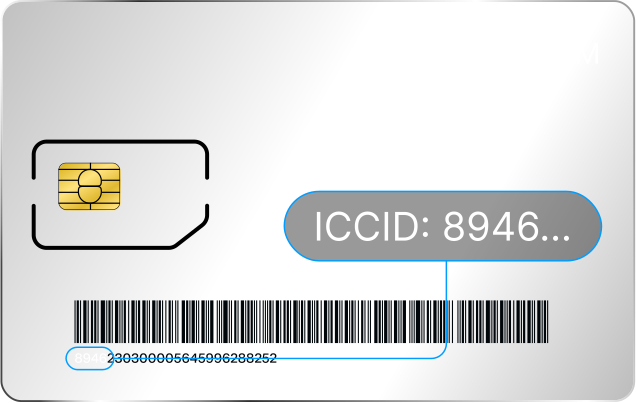
No, there is no difference between an M2M SIM card and an IoT SIM card. In fact, both terms refer to the same product and are used interchangeably. Other common names include multi-network SIM or roaming SIM.
All of these SIM cards serve exactly the same purpose: they enable various devices and machines to access the cellular network so that they can transmit data as part of M2M (machine-to-machine) communication or IoT applications.
From a technological standpoint, our M2M SIM cards support 2G (GSM/GPRS/EDGE), 3G (UMTS/HSDPA/HSPA+), 4G (LTE/LTE Advanced), 5G, as well as LTE-M and NB-IoT. Depending on roaming agreements, not every transmission technology is immediately available in every country; rather, it becomes available over time.
As soon as new cellular networks are added to our coverage, you can use the newly added networks and technologies—such as NB-IoT and 5G—with your existing or installed M2M SIM cards without having to replace them. With our M2M SIM, you’re automatically well-equipped for future technologies as well.
Unlike consumer SIM cards from network operators, our M2M SIM cards are not tied to a specific mobile network. Instead, they enable IoT devices to access all available mobile networks at their respective locations via national roaming. Since our M2M SIMs are set to unmanaged roaming by default, they allow devices to connect to the strongest mobile network at their location rather than to that of a preferred carrier.
Worldwide, devices that meet the minimum technical requirements can connect to over 485 mobile networks using our M2M SIM card. In Germany, our M2M SIM cards support all mobile networks operated by the three carriers—Telekom, Vodafone, and o2—with a single plan.
Our M2M/IoT SIM cards can use multiple mobile networks even within a single country because we have roaming agreements with network operators. These agreements allow our IoT SIMs to use other mobile networks not only when abroad, but also domestically. Without these roaming agreements, a SIM card would always be tied to its home network—that is, the network of the provider that issued the SIM. For our IoT SIM cards and M2M plans , we M2M plans entered into these roaming agreements with a large number of network operators so that we can offer our customers high data volumes at affordable rates virtually anywhere in the world.
Our M2M SIM cards have access to more than 485 mobile networks in over 189 countries worldwide. As a result, companies benefit from high network availability, international usability, and a single SIM card for a wide variety of locations.
In general, our IoT SIM cards work in any router. However, commercially available routers are usually not designed for professional use and may cause malfunctions or downtime, resulting in unnecessary costs.
For fast, stable and, above all, secure operation, we recommend M2M routers optimized for commercial and industrial use. With our PreConfig package, for example, we offer you pre-configured M2M routers with which you can easily bring your devices online - plug & play.
If you need further assistance in selecting the right hardware, our M2M experts will be happy to help.