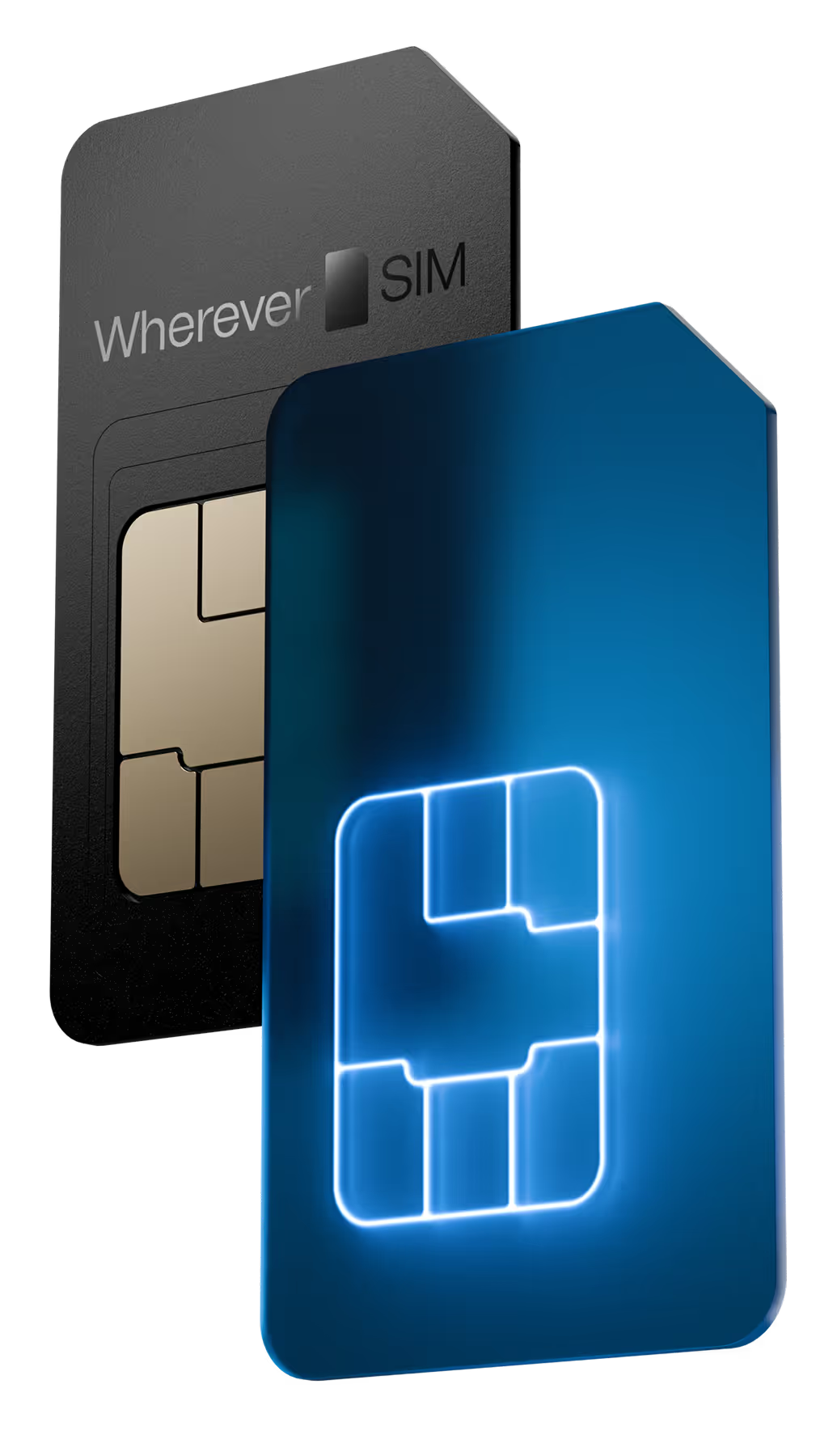
IoT SIM cards enable end devices to transmit data via mobile networks as part of M2M (machine-to-machine) communication.

Over 1,500 companies worldwide rely on WhereverSIM


Use our IoT SIM card in the free trial kit for companies and benefit from all the features of our IoT solution.
Not all IoT SIMs are the same - our SIM card offers functions that clearly stand out from those of other providers in many respects.
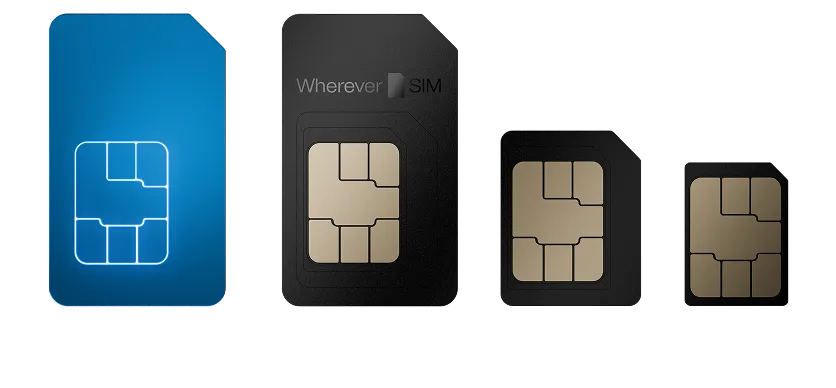
In order to meet the many different requirements and conditions of end devices and machines, IoT SIM cards are available in various formats. In addition to the classic IoT SIM formats mini, micro and nano, there are embedded SIMs that can be soldered on directly as a chip.
In addition to the standard version of the various formats, there is also an "Industrial SIM". This more robust variant is designed for an extended temperature range and a longer service life, for example.
-25°C to +85°C
500.000
10 years
-40°C to +105°C
1.000.000
10 years at -40°C to +105°C
15 years at -25°C to +85°C
2FF, 3FF, 4FF
2FF, 3FF, MFF2
Regardless of whether for M2M or IoT projects - the special requirements for the mobile radio tariff are important when used for such projects. The effort and costs involved in commissioning, maintaining and monitoring the devices must be in proportion to their value, even for devices with a relatively low value - especially if the number of units far exceeds one thousand. For this reason, traditional mobile phone tariffs with monthly bills or contract terms of 12 months or more are often unsuitable for IoT applications.
As wireless communication via M2M SIM primarily involves the transmission of data, IoT tariffs must cover a significantly larger tariff bandwidth: Depending on the application, data requirements range from just a few kilobytes to several gigabytes. Accordingly, there are a variety of different IoT tariffs and billing options specifically for IoT projects. You can easily buy the right M2M SIM card for your projects and tailor it to your requirements
Whether 1 KB or over 10 GB: we can even offer attractive prices and packages for M2M SIM cards and IoT projects with particularly high data consumption.

Data pooling is a very popular tariff model. In this constellation, all IoT SIM cards assigned to the pool use a shared data quota. This is particularly useful if the data consumption of an individual IoT SIM card fluctuates, but the additional consumption of individual SIM cards can be offset by the lower consumption of other SIMs. In data pooling, the data volume available for all IoT SIMs usually increases by a fixed amount with each additional active IoT SIM card. This means that the data volume grows in line with the number of active IoT SIM cards without users having to take anything into account or make any additional settings for each activation.
In addition to the different data packages, the available network technologies also play an important role with an IoT SIM card. In addition to the "classics" 2G, 3G and 4G, our IoT SIM cards can also use 5G networks and newer transmission technologies specially developed for the Internet of Things, such as NB-IoT (Narrowband IoT) or LTE-M (Long Term Evolution for Machines). NB-IoT and LTE-M, for example, are particularly suitable for applications that need to transmit data as energy-efficiently as possible or from areas that are difficult to access, such as basements.
Frequently asked questions about our IoT SIM solutions