An ICCID number is a unique identifier that is assigned to each SIM card. It stands for"Integrated Circuit Card Identifier" and consists of a total of 18 to 22 digits.
The ICCID number, short for "Integrated Circuit Card Identifier," is a unique identifier assigned to every SIM card (Subscriber Identity Module) worldwide for identification purposes. It typically consists of 18 to 22 digits. Each digit has a specific meaning and provides information about the manufacturer, the country, the network operator, and the individual SIM card number or phone number. Since a SIM card can be uniquely identified via the ICCID, it is sometimes also referred to as the SIM card number.
The ICCID consists of several digits, usually 18 to 22. This numerical code contains specific information about the SIM card and is divided into a total of three "information blocks". Worldwide, every ICCID number sequence begins with the digits 89, which is a standardized industry code for telecommunications services. The remaining variable digits are divided into:
Identification & Authentication: When a SIM card is activated, the device automatically searches for available cellular networks and checks whether it can access one of them. To do this, the mobile network provider reads the ICCID, among other things, to identify the user account. If all requirements are met, the device is allowed to connect. This query is particularly important when a device attempts to connect to a foreign network rather than its home network—which is especially common with IoT devices.
Portability: The ICCID allows users to transfer their SIM card from one device to another while retaining the same services and number. For example, if an M2M SIM card is removed from a GPS tracker and inserted into an IoT router instead, the router should also be able to establish a connection via the SIM card. Access to the mobile network is therefore not tied to a specific device, but to an individual SIM card.
Security: The uniqueness of each ICCID contributes to the security of mobile communications. It ensures that each SIM card is uniquely identifiable. This unique identification is particularly important in the context of the IoT and the increasing connectivity of end devices.
The IMSI (International Mobile Subscriber Identity) is another identification number stored on the SIM card. It consists of 15 digits and refers to the network, i.e., the identification of the mobile subscriber. Most SIM cards, including M2M SIM cards, typically store only a single IMSI (Single-IMSI). However, there are also special multi-IMSI SIM cards that can be used for IoT applications. Because of the different IMSIs, these SIM cards can use different profiles and may therefore have access to different networks than “standard” M2M SIM cards.
IMEI stands for "International Mobile Station Equipment Identity". It consists of a unique 15-digit serial number, which in turn can be used to uniquely identify a mobile device or end device. The IMEI is relevant for theft protection, among other things. An IMEI lock can be used to prevent an M2M SIM card from being used in a device other than the one assigned to it. This can be important for companies from whose end devices the M2M SIM could easily be stolen. If the M2M SIM with IMEI lock is bound to a device, it cannot be activated in any other end device and thus protects the actual owner from inappropriate costs.
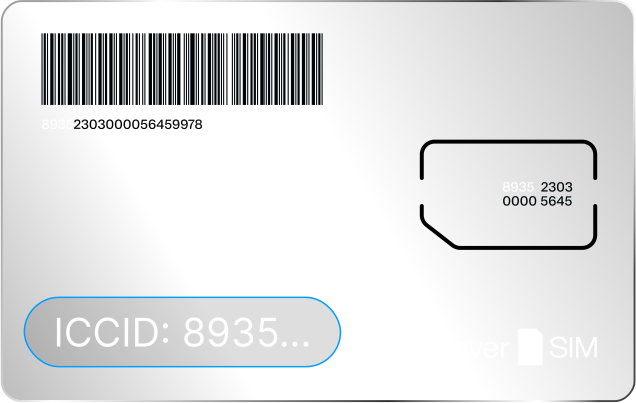
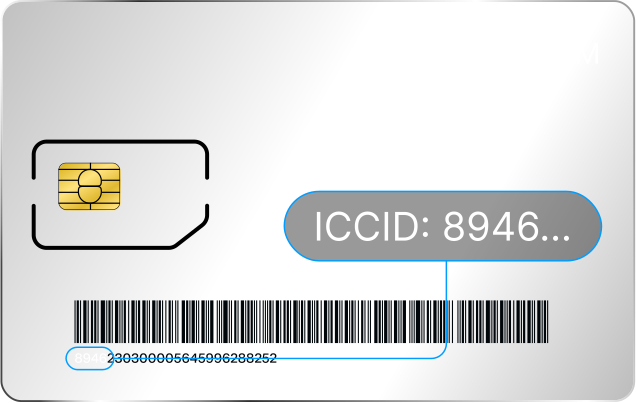
The ICCID number is usually printed on the SIM card. It can be located in different places on the card: It can appear on the front or back of the SIM card, usually near a scannable barcode.
The ICCID can also be read out by inserting it into a device and querying the ICCID number.
The ICCID number is mainly used to identify a SIM card and connect it to the associated mobile network. It is also used in the transmission of billing and network data to ensure that it comes from the correct SIM card.
By using the ICCID with various location technologies, it is possible to track the position of devices that are connected to the card. This makes the ICCID number an important part of IoT solutions.