National roaming means that a SIM card can use the mobile networks of different carriers within a single country. This "feature" is only available on special M2M SIM cards, which is why they are often referred to as roaming SIMs or multi-network SIMs.
By accessing multiple mobile networks, IoT devices are not dependent on the network coverage of a single provider. If the connection to one network is unstable or unavailable, the device can automatically switch to another available network. This ensures data transmission with as few interruptions as possible.

The Internet of Things (IoT) is growing steadily, with more IoT devices and objects being connected every day. However, in order for the data collected by IoT devices to be processed, it must be transmitted.
This is where mobile networks and WhereverSIM’s M2M SIM cards come into play. After all, mobile networks allow collected data to be transmitted quickly and securely from any IoT device. Mobile networks are an established and standardized technology, with infrastructure available almost everywhere—not just in Germany, but worldwide. That is why mobile networks are very frequently used for M2M communication and are now considered the most important connectivity technology in the IoT.
The catch here: No single mobile network operator offers the same network coverage everywhere. In Germany in particular, no single provider achieves nationwide coverage; rather, it is only the combined mobile networks of all operators that do so.
According to the Federal Network Agency (article accessed on June 1, 2026), there is still a need to improve network coverage for certain mobile network operators. Approximately 2 percent of Germany’s total land area is not yet covered by 4G or 5G. In rural areas in particular, network expansion has yet to take place, meaning that in some regions, coverage is available from only one mobile network operator at most. The specific networks available, in turn, vary from region to region.
This is exactly where National Roaming comes in: Instead of relying exclusively on the network coverage of a single mobile network provider, M2M SIM cards can access multiple mobile networks. This increases the likelihood that IoT devices can establish a stable connection at any time and reliably transmit data.
Special M2M SIM cards are required to enable IoT devices to use multiple cellular networks. Unlike traditional SIM cards for residential customers, they can access the cellular networks of different carriers—depending on the roaming agreements of the respective provider. For this reason, they are also called M2M roaming SIMs or multi-network SIMs.
This is made possible by roaming agreements between SIM providers and mobile network operators. These agreements allow M2M SIM cards to connect to different mobile networks, thereby expanding available network coverage.
However, access to multiple networks alone does not guarantee an optimal connection. It is also crucial how the end device selects between the available networks. This is precisely where the difference lies between managed and unmanaged roaming.
Not all national roaming is the same. There is a subtle but important distinction here that is, however, very important for IoT and M2M projects. We are talking about managed roaming and unmanaged roaming.
With our SIM cards, it is not the network operator that matters, but solely the strength of the available mobile network at a given location. The device is therefore free to connect to a mobile network based on network quality and does not have to follow any specific guidelines. Because of this flexibility, this is referred to as non-steered roaming.
Why is non-steered roaming ? Because the availability of a mobile network varies depending on location: sometimes one provider’s network is the strongest, other times another provider’s. However, there are devices that rely on a strong connection at all times, such as M2M SIM cards in an ambulance transmitting medical data.
In steered roaming, the device cannot choose the network for the connection on its own. There is always a clear directive (prioritization)—regardless of how poor a provider’s connection is at a given location—specifying which mobile network the device should connect to first. If a network operator issues M2M SIM cards itself, these are generally configured to prioritize its own network.
Specifically, this means: If Provider A issues an M2M SIM, it will always attempt to connect primarily to Provider A’s network—regardless of how poor the connection on that network currently is. Only when Provider A has no network coverage at all is the IoT device permitted to connect to a mobile network operated by Provider B or C.
When is steered roaming , and when does non-steered roaming offer real non-steered roaming ? Our experience from over 1,500 successful IoT projects has shown which criteria can help guide this decision:
Stationary devices at a fixed location
Non-time-sensitive data transmission
Short-term outages of the terminal device are acceptable
Selects the mobile network based on the best local connection
Network change depending on the strength of the locally available mobile network
Disconnections should and must be avoided whenever possible
Well-known locations with good/reliable service
Changing locations or regions with varying or unknown network quality
Employees can perform manual optimization
Devices should establish a connection without manual intervention
Cost Optimization or Network Operator Strategy
Maximum availability and operational reliability
non-steered roaming particular advantages in situations where IoT devices rely on a mobile connection that is as stable and consistent as possible. Since network quality can vary depending on location, building, or region, applications that regularly change location or need to continuously transmit data benefit the most.
Typical use cases include, for example, asset tracking solutions and vehicle telematics. Here, devices are constantly moving through different radio cells and coverage areas. The ability to use the strongest available cellular network at any given time helps reduce connection drops and ensures reliable transmission of location or status data.
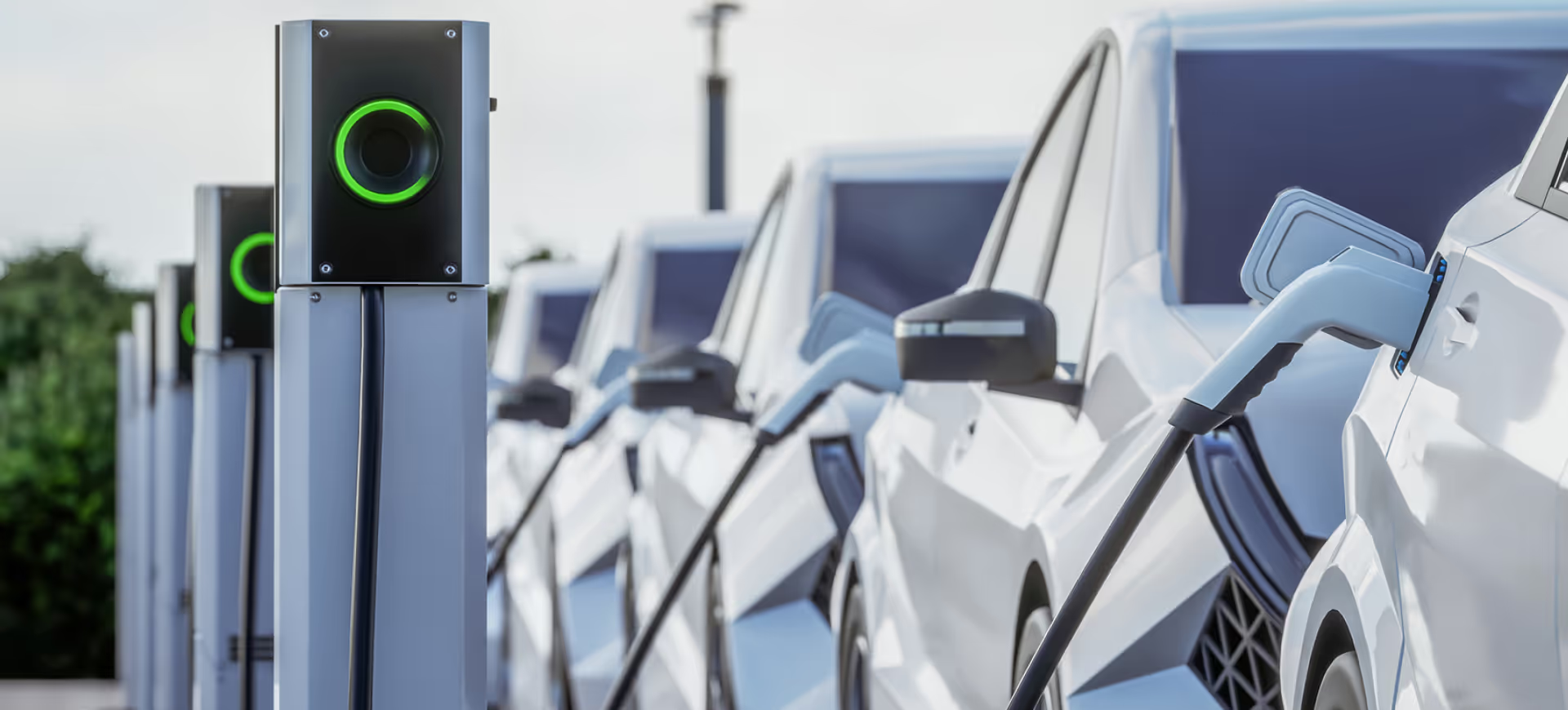
This is also the case with EV charging stations, POS terminals, and digital signage systems. If the mobile network connection fails or is unstable, payment transactions, remote maintenance, or content updates can be disrupted. Network selection increases the likelihood that devices will remain accessible at all times.
non-steered roaming is non-steered roaming particularly relevant for applications in security and alarm technology, in medical technology or emergency call systems. In these areas, the availability of data transmission can have a direct impact on functionality and operational safety. The higher the requirements for reachability, mobility, and connection quality, the greater the benefit of non-steered roaming is generally.